Rooted in data, driven by humanity.

What we do
The Vaccine Confidence Project™ (VCP) was established in 2010 by Professor Heidi Larson at the London School of Hygiene and Tropical Medicine to better understand growing vaccine scepticism around the world.
The VCP was the first research group to map and monitor public confidence in vaccination at a global scale and remains the only research group fully dedicated to understanding the roots, trends over time, and impacts of vaccine confidence.
By listening to early signs of public distrust and providing risk analysis and guidance, we aim to engage early to prevent potential programme disruptions and support vaccination rates.
About the VCP
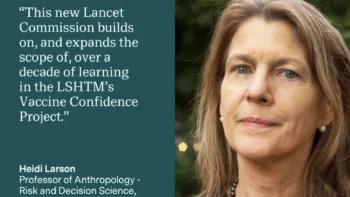
Professor Heidi Larson, VCP Founder and Director, discusses new Lancet Commission that will look to tackle wider issues and drivers around health misinformation and disinformation.
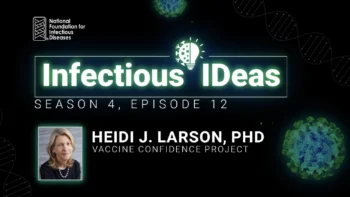
How do we build trust in an era of misinformation, social media, and artificial intelligence? In this episode of Infectious IDeas, NFID CEO Rebecca Alvania, PhD, MA, MPH, and NFID Medical Director Robert H. Hopkins, Jr., MD, talk with Heidi J. Larson, PhD, director of the Vaccine Confidence Project.

“There has definitely been a growing number of people who question widely accepted scientific evidence,” says VCP Director Heidi Larson. “We’ve always had dissenters, but it’s been very much more on the fringe,” she says.
It is time to systematically address misinformation and disinformation in a health context. A new VCP-led Lancet
Commission on rethinking misinformation, health, and human security will be convene transdisciplinary experts from to rethink a systems approach to these threats.
Vaccine Confidence Index
Our team has conducted research in over 150 countries from 2015 to the present, helping to identify critical global trends in vaccine confidence with implications for global health.
Explore the map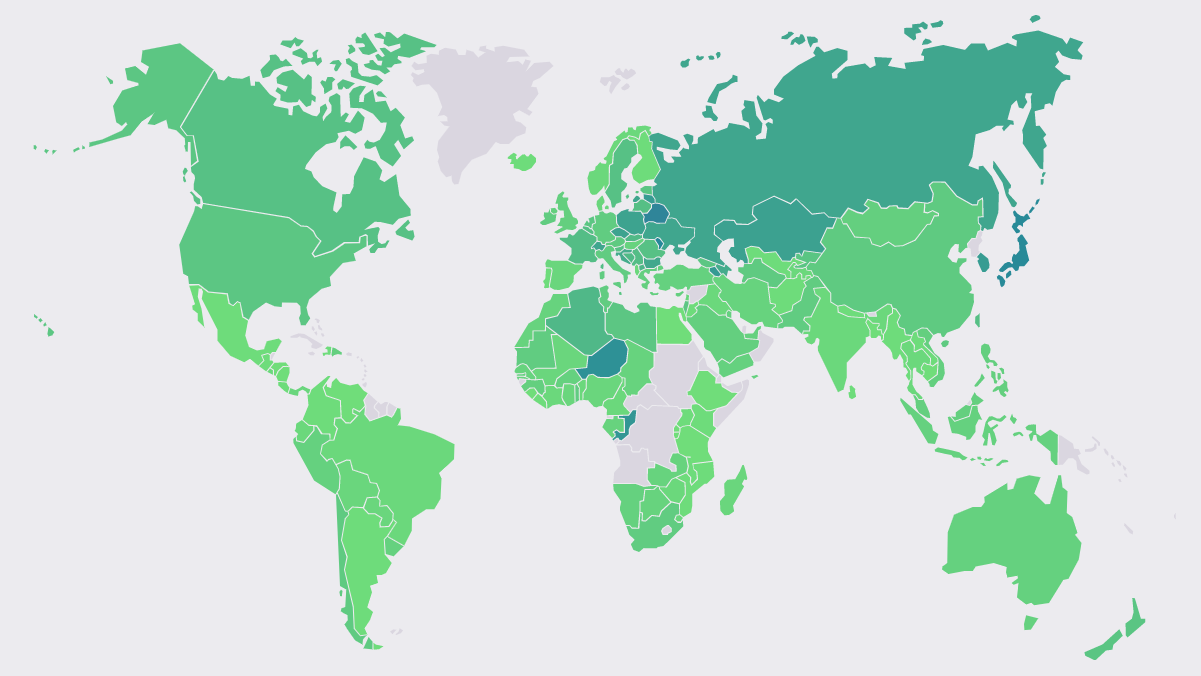
Latest research projects
The VCP conducts global research, investigating the roots, trends over time and impacts of vaccine confidence at regional, national and sub-national levels.

We partnered with Wits Vida, the Vaccine Confidence Fund, and PHRU to study how much, if at all, social media and community influencers can influence and increase uptake of influenza vaccines.

Strengthen national training curricula and integrate targeted, culturally grounded interpersonal communication practices into training curricula for health workers in ECARO countries.

Mixed method study to examine adult and HCP confidence in vaccination in Eastern Europe (Balkans, Caucasus, Central Asia).

Mixed method study to explore risk perceptions and emotional determinants of health around COVID-19 and influenza vaccination in Europe.